Digital marketing agency in Dubai Festival City that tallies enquiries from site, posts and ads
Diners at Festival Bay, tenants in the Al Badia streets and guests at the 4 hotels all search differently, and one team builds the pages, rankings, posts and campaigns that meet each of them.
Dubai Festival City runs 3 kilometres along the eastern bank of the Creek, about 2 km from the airport, and its developer puts the area at 5.2 million square metres with 30 kilometres of internal roads. That produces an odd customer map. A diner at the waterfront, a guest in one of the 4 hotels, a tenant in Marsa Plaza and a parent on the way to Deira International School occupy the same few streets and open Google with different questions. Mainland licensing runs through DET, and nothing we read places a free zone within the community. One team handles the build, the rankings, the posts and the ad accounts, so a restaurant owner, a letting agent and an events firm each receive pages shaped by their own customers, and a single monthly note totals the enquiries.
What businesses here need
Food leads, because the mall's own coverage leans that way. Press coverage of the 2017 remodel counted 75 food and beverage outlets; Market Island brings a food hall that its developer calls the largest licensed one in the Middle East, and Festival Bay puts tables on the waterfront. A diner choosing between them checks 3 things on a phone: whether there is space tonight, what the menu costs and when the kitchen closes. The mall runs 10:00 am to 10:00 pm on weekdays and to midnight at weekends, and a menu page that states those hours is easier for Google to read than a scanned PDF.
Property is the second engine. Al Badia Residences, Al Badia Hillside, Al Badia Living and Marsa Plaza sit beside Al Badia Villas, whose 107 villas on 3 hectares of parks opened for leasing on 5 January 2026. Renters search with a building or villa name attached to what they want, which gives a letting agent or property manager one page to write per name and a Google profile to keep consistent with each.
Hotels and travel come third. InterContinental has 508 rooms, Crowne Plaza 316, and Holiday Inn and the Residence Suites complete the 4. A travel desk here sells to travellers who are already within about 2 km of the airport.
Schools and children's venues finish the list. Deira International School is inside the community, Universal American School is named as a local school, and Fabyland and Stay and Play are listed as children's venues. Tutoring centres and party organisers can write for those names, while an events firm has the 7,200 square metre Festival Arena in its search terms.
Al Garhoud and Umm Ramool border the community, so a customer's search can start in any of the 3. The Dubai Creek Harbour overview shows the same job done a little further along the water.
Our services here
Web design
A page per menu, per building, per hotel and per school, each at its own Webflow address, and the plan folds in hosting and edits: SEO included, from AED 1,500 a month + VAT. A restaurant build is laid out in web design for Dubai Festival City.
SEO
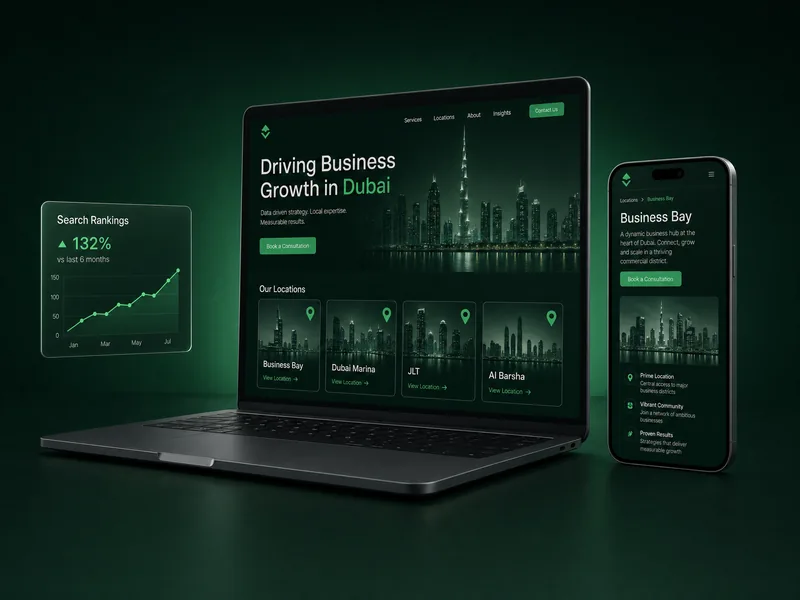
Counts come before copy. Once live, the pages hovering near the bottom of page 1 get each month's hours, and the Google profile is maintained so listings around Festival Bay and the mall remain accurate. Dubai Festival City SEO works through a brokerage's phrases.
Social media
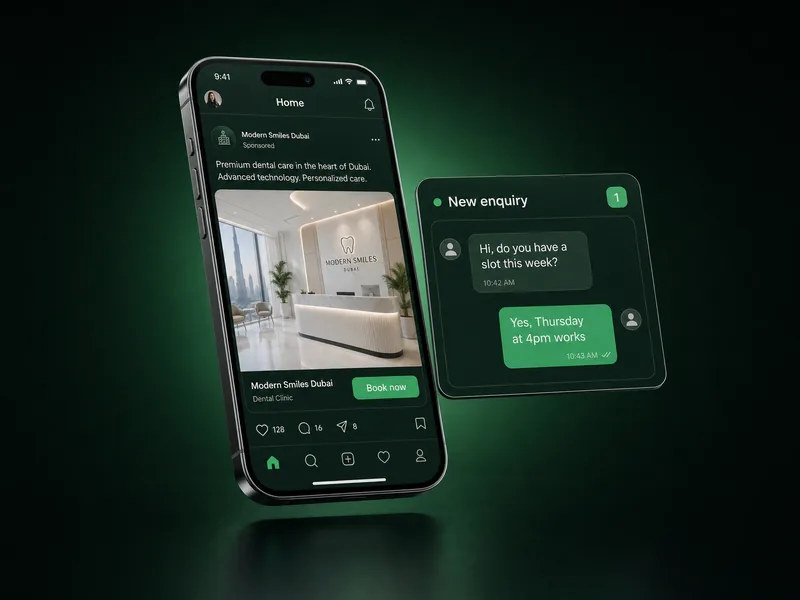
Short films shot along the promenade and inside the residential blocks become posts and stories, every one ending at a WhatsApp button, with the fee agreed after a conversation instead of read from a list. Social media for Dubai Festival City shows a property management firm's feed.
Paid ads
Google and Meta campaigns split by who is searching: guests at the hotels, families near the schools, tenants eyeing the villas. Every campaign sends its clicks to a page written for that audience, and the media budget is paid by you to Google and Meta without touching our account. Paid ads in Dubai Festival City uses a travel agency.
Frequently asked questions
What can a marketing agency take off a Dubai Festival City business owner's plate?
4 jobs that otherwise fall to whoever sits nearest a laptop: the website, getting it found, the daily posting and the ad accounts. For a restaurant manager or letting agent in Dubai Festival City they pile on top of phones and viewings. Search counts, page drafts, Google profile care and the monthly note are our side of the table, and no page goes live before you have approved it. Everything runs through 1 WhatsApp thread instead of 4 supplier inboxes.
How do I know which districts my Dubai Festival City business should target?
Start with where your customers already live and work, then let the search counts overrule instinct. A Dubai Festival City business usually begins with Al Garhoud and Umm Ramool. Al Jaddaf or Ras Al Khor join the list if the numbers support them. Every candidate comes with its monthly searches and the firms already ranking; you approve the shortlist, and the plan size of 10, 20 or 30 districts sets the limit.
Why use one team for every channel in Dubai Festival City?
Because the channels share facts that change. Opening hours are shared by every channel: the mall shuts at 10:00 pm on weekdays and midnight at weekends, and a change must reach the site, the Google profile, the ads and the posts within the week, which 4 separate suppliers seldom pull off. With one team in Dubai Festival City the change goes through once. Ads need somewhere to land and posts need somewhere to point, and the ranking pages serve both.
Does this suit every business in Dubai Festival City?
No. The model works for businesses whose customers search or send a message ahead of a visit, such as a restaurant, a letting agent, a tutor, a travel desk or an events firm. A kiosk that depends on passing footfall alone is a poor match, and so is anyone unwilling to answer WhatsApp. The first conversation settles which side of that line your Dubai Festival City business sits on, whether it serves 107 villas or one shop unit, and we say so plainly if the model is wrong for you.
A diner at Festival Bay, a tenant weighing the Al Badia streets and a traveller booking near the hotels each search for something with a place name attached, and the page that exists for that search collects the click. We write that page, push it up the results, film the posts where they happen and point each ad at its matching page. The full list of districts we cover sits on one page.
Send the menu, unit list or itinerary on WhatsApp that Dubai Festival City customers should be able to find, and the first search figures reply.
Find the plan that fits your business
Tell us what you sell and where you want work from. We look up how many people search for it each month in those districts, then send you the numbers and the plan that covers them.
What happens next
We reply on WhatsApp within the working day.
You get the search numbers for your services in your districts, and the plan that fits them.
Nothing to pay up front, whichever plan you choose.